
Blog · 6 min read
Choosing the Right Spice Format for Your Application
Choosing the right spice is only part of the sourcing process. Choosing the right format is equally important. Whole spices, ground spices, spice blends, seasonings and dehydrated ingredients can behave very differently during processing. The right choice depends on your product application, manufacturing process, desired flavour profile…
Choosing the Right Spice Format for Your Application
Choosing the right spice is only part of the sourcing process. Choosing the right format is equally important.
Whole spices, ground spices, spice blends, seasonings and dehydrated ingredients can behave very differently during processing. The right choice depends on your product application, manufacturing process, desired flavour profile, packaging requirements and target market.
For food manufacturers, private-label brands, distributors and bulk buyers, understanding these differences can help simplify sourcing, improve production consistency and ensure that the ingredient is suitable for the intended application.
Start with the Application, Not Just the Spice
Before deciding whether you need a whole, ground or blended spice, consider how the ingredient will ultimately be used.
A spice intended for industrial food manufacturing may require very different characteristics from the same spice being packed directly for retail.
Important considerations include:
- Intended food application
- Required flavour and aroma intensity
- Colour contribution
- Particle size or mesh requirement
- Mixing and dispersion behaviour
- Processing temperature
- Cooking or extraction time
- Packaging format
- Storage requirements
- Target market and destination country
Starting with these requirements helps narrow down the appropriate spice format before samples and specifications are evaluated.
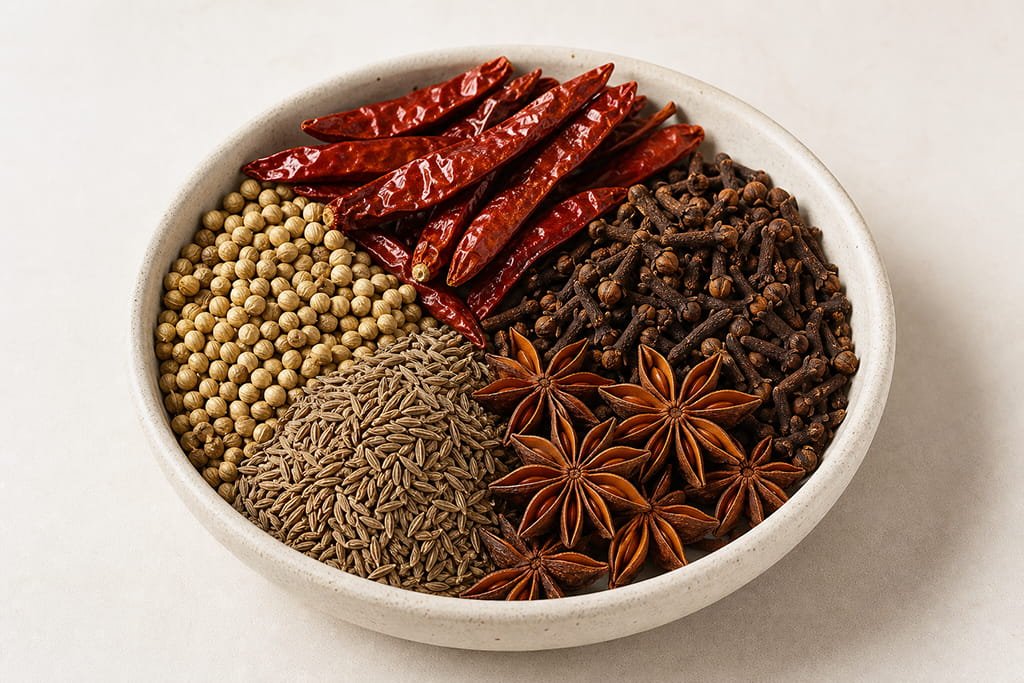
1. Whole Spices
Whole spices undergo comparatively less physical processing and retain their natural structure.
Common examples include whole cumin, coriander seeds, fennel, black pepper, cardamom, cloves and chillies.
When are whole spices suitable?
Whole spices may be preferred when the buyer requires:
- In-house grinding or milling
- Controlled flavour release during cooking
- Extraction or further processing
- Visual presence of spices in the finished product
- Greater flexibility over the final particle size
For manufacturers with their own grinding facilities, sourcing whole spices can provide greater control over processing parameters.
Whole spices are also widely used by distributors, food-service businesses and retail brands depending on the final product requirement.
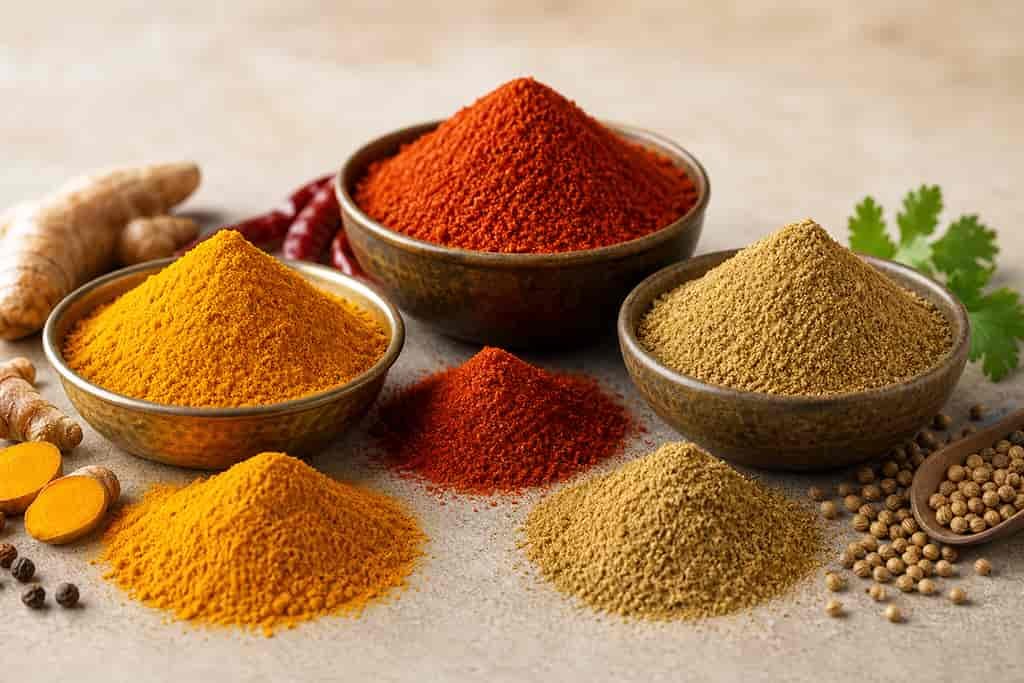
2. Ground Spices
Ground spices offer convenience and easier incorporation into food production.
Grinding transforms whole spices into powders of specified particle profiles, making them suitable for consistent dosing, mixing and formulation.
Examples include turmeric powder, chilli powder, coriander powder, cumin powder and black pepper powder.
When are ground spices suitable?
Ground formats are commonly considered for:
- Ready-to-use food formulations
- Sauces and gravies
- Snack manufacturing
- Instant foods
- Marinades
- Processed foods
- Institutional and food-service applications
- Retail spice packaging
Particle size becomes particularly important in industrial applications.
A very fine powder may behave differently from a coarser grind during mixing, cooking and packaging. Buyers should therefore communicate any specific mesh or particle-size requirements during the sourcing process.
3. Spice Blends
Sometimes the requirement is not for an individual spice but for a complete flavour profile.
This is where spice blends become relevant.
A spice blend combines multiple ingredients according to a defined formulation to achieve a particular taste, aroma, colour or culinary profile.
Depending on the application, blends may be developed for:
- Traditional recipes
- Ready-to-cook products
- Snacks
- Marinades
- Sauces
- Processed foods
- Food-service products
- Retail spice ranges
For private-label and food manufacturing projects, the formulation itself can become an important part of product differentiation.
When discussing a customised blend, buyers should ideally provide information about the intended application, preferred flavour profile, ingredient restrictions and target market.
4. Seasonings
Seasonings generally go beyond traditional spice combinations and may be formulated specifically for particular food applications.
They can be designed around the desired sensory experience of the finished product.
Applications may include:
- Snacks
- Namkeen
- Chips
- Popcorn
- Instant foods
- Ready-to-eat products
- Marinades
- Food-service products
For seasoning development, factors such as flavour intensity, coating behaviour, particle size and application rate can influence the final formulation.
Providing information about the finished product helps manufacturers evaluate the requirement more effectively.
5. Dehydrated Ingredients
Dehydrated products provide another practical format for industrial food applications.
Ingredients such as dehydrated onion, garlic and other vegetables can be supplied in different forms depending on the intended use.
These may include:
- Flakes
- Granules
- Minced formats
- Powders
Dehydrated ingredients can be particularly useful where manufacturers require easier storage, controlled ingredient handling and convenient incorporation into dry or processed formulations.
They are commonly used in seasoning systems, soups, sauces, instant foods, snacks and ready-to-cook products.
Processing Conditions Matter
The correct spice format cannot be selected independently of the manufacturing process.
Several processing conditions can affect how an ingredient performs.
Particle Size
Particle size influences dispersion, texture, appearance and processing behaviour.
Mixing
A spice must distribute appropriately throughout the formulation. The ideal format may therefore depend on the type and duration of mixing.
Heat Exposure
Cooking, roasting or other thermal processing can influence aroma and flavour development.
Moisture
Moisture conditions within both the ingredient and finished product can affect handling and storage considerations.
Packaging
The format must also be compatible with the intended packaging system, whether the product is being supplied in bulk or prepared for retail distribution.
Discussing these conditions early can make sample development and specification discussions more productive.
Bulk Supply and Retail-Ready Products Require Different Planning
The same spice can require very different supply arrangements depending on how it reaches the customer.
For example, a food manufacturer purchasing ground spices for production may prioritise bulk packaging, technical specifications and production consistency.
A private-label brand may additionally require:
- Consumer packaging
- Pack-size selection
- Label development
- Brand presentation
- Product assortment planning
- Export documentation
- Destination-market requirements
The spice format should therefore be considered as part of the complete product and supply programme rather than as an isolated purchasing decision.
What Should You Share with Your Spice Supplier?
A clear initial enquiry can significantly improve the sourcing process.
When approaching a spice manufacturer or supplier, consider sharing:
Product:
Which spice, blend, seasoning or dehydrated ingredient do you require?
Format:
Whole, ground, blended, flakes, granules or another specific format?
Application:
How will the ingredient be used?
Specification:
Do you have requirements relating to particle size, formulation or other technical parameters?
Quantity:
What is your estimated order volume?
Packaging:
Do you require bulk packaging, food-service packs or retail/private-label packaging?
Destination:
Which country or market is the product intended for?
Providing this information from the beginning helps keep product selection, sampling, quotation and documentation discussions aligned.
Choosing the Right Format: A Quick Guide
| Requirement | Format to Consider |
|---|---|
| In-house grinding or further processing | Whole Spices |
| Consistent dosing and easy incorporation | Ground Spices |
| Defined flavour formulation | Spice Blends |
| Application-specific flavour system | Seasonings |
| Dry onion, garlic or vegetable ingredients | Dehydrated Products |
| Consumer-ready branded products | Retail / Private-Label Formats |
The final selection should always be based on the specific application, processing conditions and required product specification.
Work with a Manufacturer Who Understands the Application
Selecting a spice supplier should involve more than comparing product names and prices.
For B2B sourcing, it is important to communicate the application, required format, specification, packaging and destination market clearly.
At Aditya Food Product, we work with food brands, manufacturers, distributors, retailers and international buyers across requirements for whole spices, ground spices, spice blends, seasonings and dehydrated products.
Whether you are sourcing ingredients for food manufacturing, developing a private-label range or evaluating products for export, sharing a detailed requirement helps our team understand your application and recommend an appropriate supply format.
Discuss Your Requirement
Looking for spices, seasonings or dehydrated ingredients for your business?
Share your product, format, approximate quantity, packaging preference and destination market with the Aditya Food Product team to begin the discussion.
Aditya Food Product
Indian Spice Manufacturer | Private Label | Bulk & Export Supply